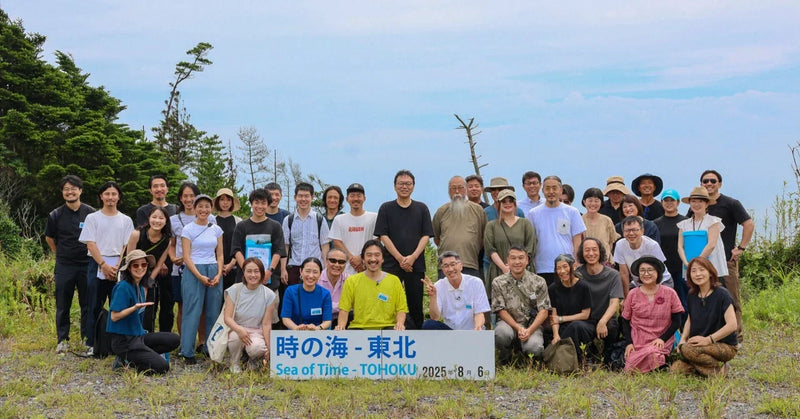
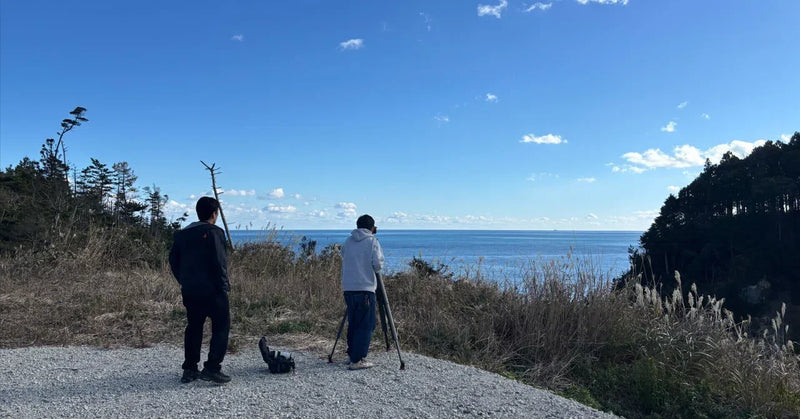
The "Sea of Time - TOHOKU" project is an art project created by contemporary artist Tatsuo Miyajima, known for his works using digital counters, with the hope of commemorating the victims of the Great East Japan Earthquake and passing on the memories of the disaster. It is made in collaboration with people living in Tohoku and those who care about Tohoku.
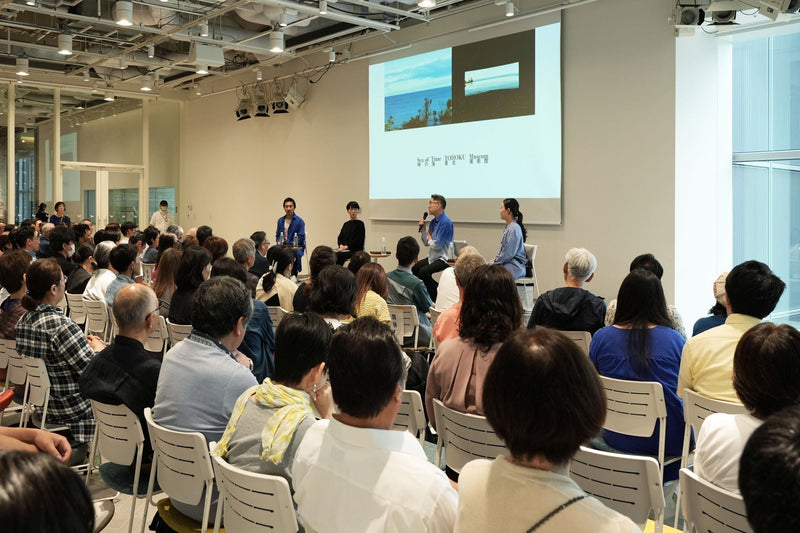
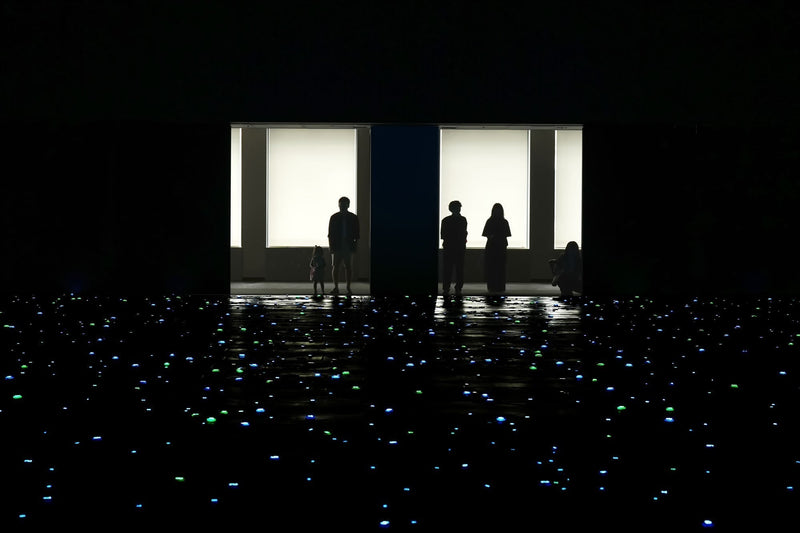
The artwork "Sea of Time - TOHOKU" consists of 3,000 LED counter gadgets shining in a 22.5 x 40m water basin, filled with the thoughts of 3,000 people who participated in workshops. It has been decided to construct a new museum in Tomioka Town, Fukushima Prefecture, for the permanent installation of this work. A press conference was held on February 3, 2025, at Hills Cafe/Space in Roppongi, Tokyo. This article reports on the event, which was attended by 102 people (including 32 participants from Tomioka Town).
Text by Satomi Haraguchi (Public Relations, "Sea of Time - TOHOKU" Project)
Photos by Emiko Nishizuka (Staff, "Sea of Time - TOHOKU" Project)
Presentation
The moderator was freelance announcer Ayano Sato, who has also participated in a time-setting workshop in the past. Under the warm guidance of Sato, who is also a collaborating artist of "Sea of Time - TOHOKU," the first half of the presentation began.
Also in attendance at the venue were Mayor Ikuo Yamamoto and Deputy Mayor Daishi Miyakawa from Tomioka Town, where the museum is planned to be built.
"This museum is a new kind of place, beyond just a facility"
 Myo Kahara, Project Director
The first presenter was Myo Kahara, Project Director of "Sea of Time - TOHOKU." She graduated from Kyoto University of Art and Design (formerly Kyoto Zokei Geijutsu University), where Miyajima served as Vice President at the time. With a long-standing connection to Miyajima, having handled the permanent installation project of his work at the Kunisaki Peninsula Art Festival, she was appointed as the Project Director.
Kahara provided an update on the project's current status, stating that the total number of workshop participants had reached 2,744 (as of January 31). She also explained the history and current situation of Tomioka Town following the Fukushima Daiichi Nuclear Power Plant accident, as well as the planned museum site, accompanied by video footage (※Video to be released online soon).
She also announced that land acquisition for the planned site has been completed, and full-scale museum construction will now begin, with a fundraising goal of 2 billion yen. She stated that the fundraising effort would not rely on crowdfunding but rather involve a "collaborative mechanism with various people," similar to the artwork's creation, and expressed a wide call for partners.
Finally, she expressed her hope that the planned museum would not only serve as a facility but also function as a community art center, with "Sea of Time - TOHOKU" at its core, and become a hub for the community. She also expressed her anticipation of continued dialogue with local residents to shape its identity moving forward.
"Hope does not come from knowledge. Hope comes from real experiences and imagination."
 Tatsuo Miyajima, contemporary artist
The next presenter was contemporary artist Tatsuo Miyajima. After an introduction to his long career as an artist, where he has consistently expressed themes of life and death, and the eternity of life symbolized by the LED counters used in his work, he spoke about the background of the "Sea of Time - TOHOKU" project.
At the time of 3.11, Miyajima was the Vice President of Tohoku University of Art and Design. In addition to his university activities, he also engaged in personal volunteer work and fundraising. However, he gradually felt a growing sense of crisis as the reality of the disaster began to fade outside of Tokyo and the affected areas. He said that despite often saying "art changes the world," he was "frustrated that as an artist, he couldn't move society even an inch" in the immediate aftermath of the disaster's recovery, and that "Sea of Time - TOHOKU" is also a project to settle accounts with his past self.
Since the project's conception in 2015, Miyajima has continued activities such as "Sea of Time - TOHOKU" workshops and exhibitions. Over several years, he searched for land along the coast from Aomori to Ibaraki, and the hill overlooking the sea, which he was serendipitously introduced to by an official from Tomioka Town, was truly an ideal location.
 Aerial photo of the land taken by drone (Photo by Yuki Iwanami)
However, Miyajima felt a lingering sense of unease about the fact that this land was located midway between the Fukushima Daiichi and Daini Nuclear Power Plants. Despite these feelings, he said that through his interactions with the people of Hamadori, Fukushima, he came to personally experience "Tohoku's present."
The nuclear accident forced the evacuation of the entire town, creating a "zero-base" where time seemed to stand still. People started businesses to take on new challenges, some returned, others moved in, and the children at Tomioka Town Elementary School, with whom he interacted through the "PinS Project (Professionals in School)" in 2019 – seeing all these people struggling but moving forward made him realize, "What is art if it doesn't move forward with the people who are actually living there?" Miyajima said that his initial image of the land was nothing more than "armchair theory," and he asserted, "Hope does not come from knowledge. Hope comes from real experiences, real lives, and imagination. This place in Tomioka Town is the best place for 'Sea of Time - TOHOKU'."
"I don't want to be an adult who can't create a place for their future, a place where they can grow up."
 Architect Tsuyoshi Tane (ATTA – Atelier Tsuyoshi Tane Architects)
The final presenter was architect Tsuyoshi Tane. From his perspective, as an architect who builds from the "memory of a place," he discussed how he views the planned site and Tomioka Town, and his approach to architecture.
Tomioka Town had a blank period of 10 years when no one lived there, and people are just now starting to return. To think about how to build the future, he said they began by digging into the deep memories of the planned construction site.
This place, seemingly wide open between the sea and the mountains, was cultivated as farmland after the mountains were cleared, then became a sewage treatment plant, became dysfunctional due to landslides caused by the earthquake, and was then reclaimed and leveled. He investigated how it developed as a route connecting Tohoku and Edo in the Edo period. He also archaeologically traced the memory of the place from various angles, including the geological history of the location and traces of the people who lived there in the Hamadori cultural area.
Even Mr. Tane admitted that before getting involved in the project, he felt a sense of anxiety and fear about the unknown, wondering, "What can architecture and art do in Fukushima, a place affected by both the earthquake, tsunami, and nuclear accident?" However, after interacting with local residents and seeing children running around loudly at the elementary school, he realized, "I don't want to be an adult who can't create a place for their future, a place where they can grow up," and decided to take on this project.
 Architectural model. The coastline extends from the cliff on the lower left.
The museum building features a roof that covers the entire structure, with a huge artwork installed inside that connects to the sea beyond. He expressed his hope that the building itself, along with the artwork, will naturally transform with nature and time, and that it will become a place where the people of Tomioka and visitors can look towards the future, while supporting various ways for people to confront nature and interact with the artwork.
He also expressed his desire for the museum to become a central point where people gather every year on March 11th to reflect and dedicate their thoughts.
Voices of the Project Members
The latter half of the event, moderated by Project Director Kahara, was a session to hear the "voices of the project members."
Rikako Nagashima, who is in charge of the museum's graphic design, and Hidefumi Endo, who runs a construction consulting company while also producing wine in Tomioka Town, were invited to the stage. They each expressed their thoughts and expectations for the construction of the museum in Tomioka Town.
 Rikako Nagashima, Graphic Designer (village®)
Ms. Nagashima, who visited Fukushima for the first time in 10 years to participate in the project, said:
“During my first visit, I was staring blankly, with questions like 'What can I do?' and a sense of my own insignificance in my heart. During my visit 10 years later, I witnessed both drastic changes and things that remained the same. In turn, I asked myself, 'What about me? How have I spent this same amount of time, both as a designer and as a person?' Honestly, I still don't know how I, living in Tokyo, will be involved in that place in the future, but I am thinking about how to give shape to this uncertainty. One thing I can say is that I am happy to be involved. Looking back at my past life, no one is unrelated to Fukushima, and despite that, I feel disappointed in myself for not being able to resist the flow of oblivion in my urban life. I definitely want to continue to think about it and ask myself questions, even from afar, so I am happy to be involved in this project."
 Hidefumi Endo, President and CEO of Futaba Co., Ltd., Representative Director of Tomioka Wine Domaine General Incorporated Association, and one of the proponents of the newly established "Sea of Time - TOHOKU Museum Support Group"
Mr. Endo, also a founding member of the support group, spoke about the commonalities between Tomioka Wine and the "Sea of Time - TOHOKU" project: "sea," "numbers," and "involvement."
Mr. Endo shared his experience of losing his newly built home to the tsunami just six months before the disaster, but also spoke of the sea, which he had been familiar with since childhood, as a great presence for him. He said that when cultivating his vineyard, he also chose a hill overlooking the Pacific Ocean. Furthermore, just as "Sea of Time - TOHOKU" emphasizes the number 3,000 (3,000 LED counters), he is particular about the number of grape seedlings in his vineyard, 16,000, which he said represents the population of Tomioka Town before the disaster. Even now, with a return rate of 6-7%, he is conscious of the fact that so many people once lived there, and is considering what kind of town to build next. With the desire to lay the foundation for town development, he continues to plant seedlings, aiming for the target number.
Tomioka Wine's activities began with 10 town residents gathering from evacuation shelters. Over the years, many volunteers from various regions have become involved, and some have even decided to relocate as they continued their involvement. Cherishing these connections, he hopes to create a comfortable town for everyone through wine, with their own hands. He said, "Once the museum is completed, the number of 'points' in Hamadori will increase. As points increase, lines will increase, and it will become a surface. I want to expand that surface more and more."

Finally, in response to Kahara's question, "What kind of museum would be ideal, and how should we build it?", Mr. Endo and Mr. Tane offered their comments.
"There is no precedent in the world for a disaster-stricken area experiencing a complex disaster of earthquake, tsunami, and nuclear accident. This place, where there is no textbook, could be a starting point for the difficult and valuable question of how to live and build a town from scratch. I would be happy if it became a place where we can imagine a positive future," said Mr. Endo.
"Construction inevitably involves human effort. While machinery will be used, this time we want to create a process that involves 'human hands.' In the construction and repair of temples and shrines, there has been a concept called 'Fushin' since ancient times. Those with strength would carry and assemble materials, while others would support their food, and children would pick up stones or firm the earth. It is a way for various people to be involved in architecture, and we plan to inherit this concept and create points where everyone can collaborate, just like with the artwork," said Mr. Tane.
Support group from Tomioka Town also participated
 Group photo with everyone who came from Tomioka Town
Many "supporters" from Tomioka Town came to the press conference. These included the creators of Tomioka Town's specialty products, who offered their goods at the social gathering after the event; local workers at the "Sea of Time - TOHOKU" Tomioka Town office and their children; and local residents who had previously participated in workshops. There were so many people with connections to the project in various ways that the venue had a unique, warm atmosphere, unlike a typical press conference.
Atmosphere of the venue reflecting the actual site
Although the event was held in Tokyo, far from the planned site, we wanted to convey a sense of the place. Therefore, large-format prints of photos of the planned site by photographer Yuki Iwanami were displayed at the venue.
 Photo by Yuki Iwanami
 Photo by Yuki Iwanami
 Photo by Yuki Iwanami
In front of the photographs, an architectural model was placed, and visitors carefully observed the dynamic architecture and the unique characteristics of the land.
As Miyajima's words "hope comes from real experience and imagination" suggest, we hope that by experiencing the site through these photos and models, you will be inspired to visit the actual location once the museum is built.

SPECIAL THANKS
Venue
Hills Cafe/Space, Mori Building Co., Ltd.
Exhibited Photos
Yuki Iwanami
Architectural Model
ATTA - Atelier Tsuyoshi Tane Architects
Video
Masato Nishino
Handouts
Brochure/Booklet Design: Rika Nishiyama (marutt Co., Ltd.)
English Translation: Sam Holden
Food and Beverage Provided by
- Tomioka Wine Chardonnay 2023 (Provided by: Tomioka Wine Domaine General Incorporated Association)
- Tomioka Damashii (Provided by: Tomioka Plus General Incorporated Association)
- Yonomori Baum (Provided by: BAUM HOUSE YONOMORI)
- Soka Senbei (Provided by: Tomioka Town Tourism Association)
Public Relations
Iroiro Co., Ltd.
In conjunction with this announcement, the "Sea of Time - TOHOKU" project has launched a new interview series on note titled "Meeting the People of 'Sea of Time - TOHOKU'".
Meeting the People of "Sea of Time - TOHOKU"
This series visits people who have participated in "Time Setting"* in the past and re-interviews them about the seconds and thoughts they decided on, as well as their current lives and activities.
We hope you will listen to each individual's voice and thoughts through these articles.
And if you are interested in supporting this project, please feel free to contact us.