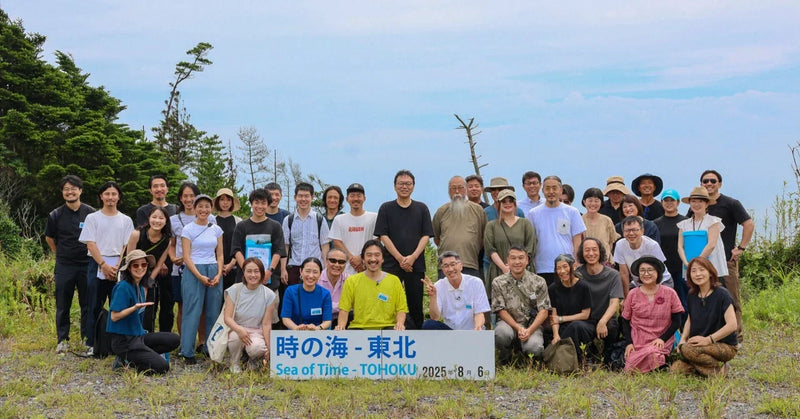
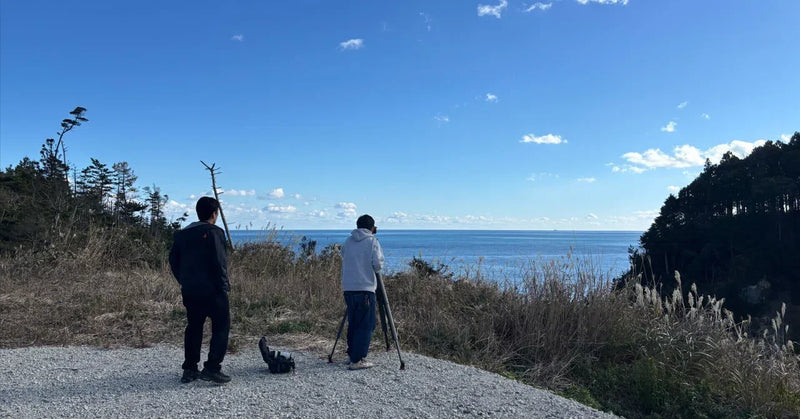
The time-setting workshop for the "Sea of Time - Tohoku" art project, which started in 2017, was held in Tokyo for the first time.
To date, over 1,800 people have participated. On this day, too, about 100 participants gathered from Tokyo and its vicinity, as well as from as far away as Kyushu, Sanyo, Kansai, and Tokai regions.
In this report, we will provide an account of the workshop from the perspective of a writer who experienced it firsthand.
Author
Emi Sato (Editor/Writer)
Photography
Hajime Kato (Photographer)
First Time-Setting Workshop in Tokyo
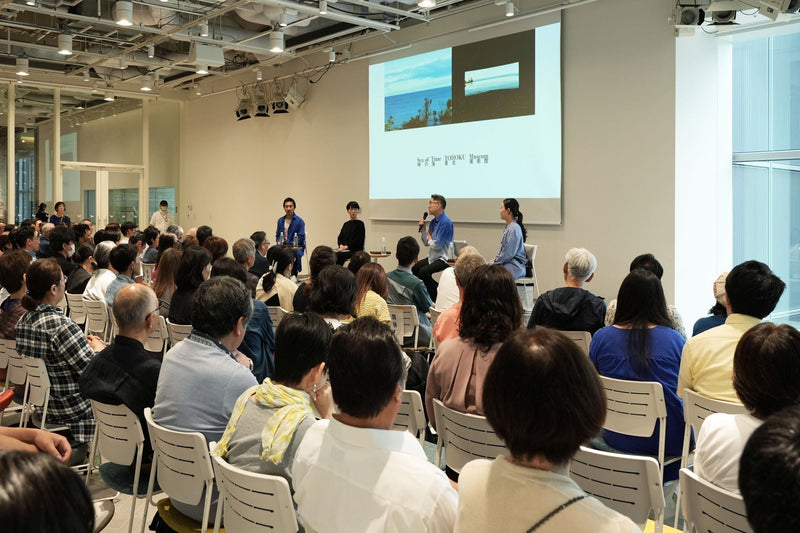
On March 11, 2023, exactly 12 years after the Great East Japan Earthquake, a time-setting workshop for the "Sea of Time - Tohoku" project (hereinafter referred to as "Sea of Time") was held at YAU STUDIO in front of Yurakucho Station in Tokyo.
"Sea of Time," which started in 2017, is an art project conceived by contemporary artist Tatsuo Miyajima in response to the Great East Japan Earthquake.
It aims to create a time and place for various reflections by permanently installing 3,000 LED gadgets, each displaying a different countdown speed set by 3,000 participants, and the thoughts embedded in those numbers, at a location overlooking the Tohoku sea.
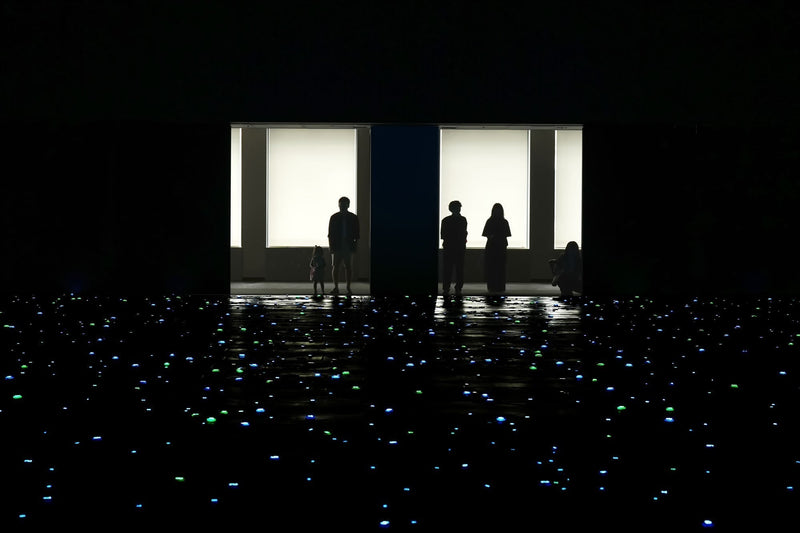
 A demonstration artwork of "Sea of Time - Tohoku" displayed at the venue on the day of the workshop
 Sketch of Tatsuo Miyajima's "Sea of Time - Tohoku" (2018)
The LED numbers that form the artwork repeatedly count down from 9 to 1. In the workshop, participants set the speed of this countdown from 0.2 to 120.0 seconds and verbalized the thoughts they put into that specific duration. While it has been held in various locations across Japan and online since 2017, this was actually the first time it was held in Tokyo. On this day, two approximately one-hour workshops were conducted, with 109 participants ranging from infants to people in their 70s.
 The time filled out by participants becomes the artwork
 YAU STUDIO, where the workshop was held, is a shared studio located on the 10th floor of the Yurakucho Building (completed in 1966), which is scheduled for demolition in 2023. The executive committee is comprised of the NPO Daimaruyu Area Management Association, the Otemachi/Marunouchi/Yurakucho District Town Development Council, and Mitsubishi Estate Co., Ltd., and it is part of the " Yurakucho Art Urbanism (YAU)" pilot program aimed at realizing a city with artists.
To Prevent Memories of the Great East Japan Earthquake from Fading
From YAU STUDIO, where the event was held, one could clearly see the high-rise buildings of Yurakucho, Tokyo. Below, the JR Yurakucho Station and trains running on the tracks were visible. Twelve years ago, the streets of Tokyo also shook violently. Looking out at the usual everyday scenery, I found myself suddenly recalling the memories and events of that day. Such was the setting for this workshop.
As the workshop began, Project Director Tae Yoshihara first explained the overall flow. This time, sign language interpretation was also incorporated, introducing "Sea of Time" expressed in sign language. Then, all participants offered a silent prayer. The lights were turned off, and a minute of quiet contemplation followed.

 Explanation of how to express "Sea of Time" in sign language
 Participants observing a moment of silence with the lights off
After the silent prayer, Miyajima introduced the project. He has been creating LED artworks with counting numbers for over 30 years. He first presented an artwork in 1988. In the same year, for the "Art House Project Kadoya" on Naoshima Island in the Seto Inland Sea, he created an artwork with the participation of 125 island residents. In addition, his works and activities have been presented in various locations both domestically and internationally, including the Museum of Contemporary Art Tokyo, the Venice Biennale in Italy, and the International Commerce Centre (ICC) in Hong Kong, among others.
 The monitor shows "Sea of Time - Tohoku" when it was exhibited at the Mori Art Museum's "STARS: Six Contemporary Artists from Japan to the World" exhibition (2020)
The catalyst for "Sea of Time" goes back to Miyajima's personal experience of the Great East Japan Earthquake. At the time of the disaster, Miyajima, who was working at Tohoku University of Art and Design, entered the affected areas to confirm the safety of his students and volunteer, witnessing the situation firsthand. He said he felt the helplessness of humanity and was unable to create art for about a year. However, as time passed, life in the Tokyo metropolitan area gradually returned to normal, and memories of the disaster slowly faded. Miyajima felt a strong sense of crisis about this fading and felt that as an artist, he had to do something, so he launched this project.
 Miyajima introduces the project, stating, "The actual LEDs will be in shades of blue and green, and colors in between, to evoke the image of the sea."
Miyajima: My artwork features LED counters that count down from 9 to 1, and then return to 9 without displaying 0. The perpetually repeating numerical count expresses the perpetuity of life. I would like to have each of you set the speed of this countdown and then install 3,000 LED counter artworks, imbued with the thoughts of people from affected areas and other regions, in a location overlooking the Tohoku sea. Please think of your favorite number, your preferred duration in seconds.

Imbuing a favorite number with feelings
For about 30 minutes, participants freely set their numbers. Some started writing immediately, some pondered before writing, and others consulted with family or friends they came with... Each person reflected on their own thoughts.


Participants who finished writing submitted their forms to the staff. The staff listened to the thoughts embedded in the numbers and collected the forms.

Here are some glimpses and voices of participants in the workshop. A fifth-grade boy who participated after seeing Miyajima's work at the "STARS" exhibition at the Mori Art Museum chose "1 second," while his aunt, who also participated, chose "5.5 seconds."
Boy: I chose '1' for 'ichiban' (number one) to remind myself to always strive to be the best even at things I'm not good at.
Aunt: I've visited Miyajima-san's artwork in Naoshima several times and always wanted to participate, so I'm happy to be here today. My grandmother was born in the last year of the Meiji era, and thinking about family connections, I wanted to choose her birthday.
Another woman living in Tokyo, who chose a number related to her own birthday, said she was living in Sendai 12 years ago and spoke about the time of the earthquake:
"On the day of the earthquake, my mobile phone wasn't working and there was no information, so I thought everything would be back to normal the next day. But all the lifelines stopped, and I felt uneasy at home, so I spent several days in an evacuation center with friends from the neighborhood. Later, when I learned about the immense damage from the tsunami, I realized that I was alive. If I'm alive, I don't want to have any regrets in my life. Thinking that, I moved to Tokyo that year. Then, after a while, I happened to encounter Miyajima-san's artwork at the Mori Art Museum, and I wanted to participate in this workshop, so I came today."

A woman who participated with her mother said that she couldn't think of any numbers at first, but was grateful that it gave her a chance to remember that time, and set her own starting number.
"I wrote 1.10 seconds. The reason is that I lost my hearing when I was 1 year and 10 months old. I made it my starting line number."
The mother, who said her daughter invited her to participate, reflected on that time and said:
"I was in Tokyo during the earthquake. My daughter was in junior high first grade, and my son was in elementary school fourth grade, and on that day I had to go pick them up from school, which made me very anxious. I remember feeling relieved when everyone in my family returned home safely. However, I was deeply shocked by the news from Tohoku. My family and I are deaf, so sometimes information is insufficient. It made me realize that I need to plan how I would meet my family if a disaster happened again. In that sense, I thought it was important to properly remember 3.11, so I participated."

0.2 to 120.0: The Thoughts Behind the Numbers
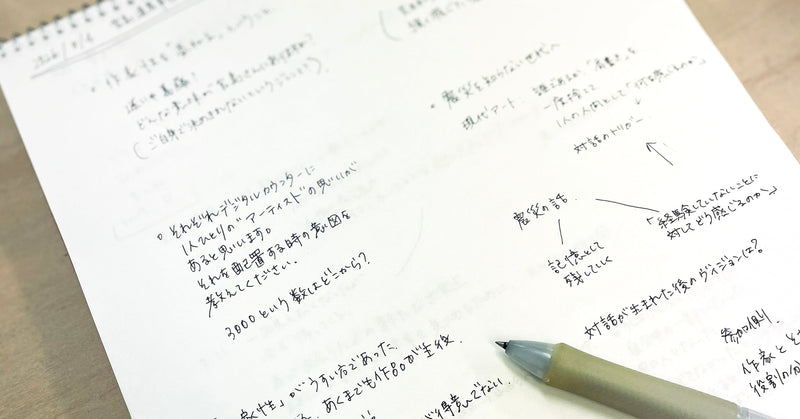
After all participants had finished writing their numbers and comments, Yoshihara read out some of the comments. Many people set their times recalling 12 years ago, while others chose numbers based on their names or birthdays, or numbers related to someone important to them. Here are a few examples:
11.1 seconds
Recently, reading about the recovery efforts in Fukushima, I keenly felt that I hadn't been keeping up with the situation. I wanted to participate to reflect on it once again. I chose repeating numbers because I feel a sense of stability. I chose 1 to signify a beginning.
12.00 seconds
Twelve years have passed since the Great East Japan Earthquake, and some of it has faded in my memory. At that time, I was in second grade and didn't really understand the news that was constantly on. Now that I'm older, I've come to understand what happened during the Great East Japan Earthquake. So now, I wanted to revisit the Great East Japan Earthquake again and participated.
(Born in 2001)
60 seconds
On the day of the earthquake, after my family was safely together and we were discussing what to do at home, I distinctly remember eating homemade cheesecake from the refrigerator. I chose 6 for our family of six. I added 0 because I like the duration of one minute. I want to continue remembering that feeling from that time.
(Born in 2002)
8 seconds
I chose my age when the Great East Japan Earthquake occurred. I can't forget the experience of discussing with my teacher and friends at school, "Did it just shake a little?", and then watching the tsunami footage on TV after returning home, which shocked me deeply.
(Born in 2002)
40 seconds
On 3/11, my son was 40 days old. Although there wasn't much damage in Kanagawa, the power went out, and I remember changing his diaper by the small light on my bicycle. The power was restored just before midnight, and my husband came home just after midnight, which relieved me. My son, who was a baby then, has now graduated from elementary school, and I'm grateful he's grown up healthy.
(Born in 1978)
3.7 seconds
It's my mother's death anniversary. An acquaintance in Tohoku passed away. I still can't believe it. Participating this time, the words "On that day, at that time, let's go see that person" are resonating more and more in my heart.
(Born in 1965)
5 seconds
This is the sum of my birth date, reduced to a single digit. I chose it because I believe my existence exists within something, and is connected and involved. I want to convey my unwavering feelings to the people of Tohoku, even if there is distance.
(Born in 1977)
71.4 seconds
This number represents the date I started dating someone I love. It was my first relationship and a special day in my life. I hope that even if another major earthquake or disaster happens and I am gone, this moment of the Sea of Time will continue to shine.
(Born in 2001)
10 seconds
10 is bigger than 1, and it's plenty of time.
(Future dream) I went to see the "Stars Exhibition," so I want to be an artist.
(Born in 2014)
1 second
The reason I chose this number is because it's always the same. I felt that the flow of time we always experience and the flow of time when 3/11 happened were the same. Also, with the thought of "moving forward even one minute and one second at a time," I chose 1 second. I'm looking forward to the artwork being completed in a place where the Tohoku sea can be seen.
(Born in 1997)
Finally, all participants took a group photo, and the workshop concluded. A couple who said, "My daughter living in Naoshima told me about this, so we participated today," commented, "It was a very heartwarming workshop. We must not forget 3.11, and we're glad we could participate on this day."
 Commemorative photo with participants!
 Thank you for participating!!
Passing down stories through art that are usually left unspoken
Finally, I asked Miyajima about his thoughts on this workshop and his impressions after it concluded.
Miyajima: I believe there is significance in holding this event in Tokyo on March 11. The project itself began because I felt that memories of the disaster were gradually fading in Tokyo. Although there is a physical distance from Tohoku, the Fukushima nuclear power plant, where the accident occurred, supplied electricity to Tokyo and the Kanto region, indicating a deep connection. I felt a sense of crisis that this connection might be forgotten.
We hold this workshop in various parts of Japan, and even in locations outside of Tohoku, many people discuss their connection to the disaster. They might say they had relatives there, or they moved from Tohoku after the disaster. There are still people across the country who hold Tohoku in their thoughts. At that time, images of the affected areas were broadcast nationwide through television and the internet, weren't they? I believe not only Tohoku but all of Japan was affected and wounded. I also heard regrets from people who couldn't volunteer or help at the time. I think the impact was felt everywhere.
 Japan University Buzan Girls' High School Gymnastics Club and Miyajima
Students from a high school gymnastics club in Tokyo participated in this workshop. They told us they would be using "Sea of Time" as the theme for their creative dance. Their teacher saw my work at the Mori Art Museum and consulted with me, expressing a desire to create a dance together based on this theme. They want to inherit the memory and use it in their expression. High school students might have been too young 12 years ago to have clear memories of the earthquake. But it made me very happy that such young people wanted to take up "Sea of Time."
Furthermore, among today's participants, there was one person who wrote extensively about the day of the earthquake on the back of the form. When I spoke to them, they said they had wanted to talk about it with someone. After 12 years, there are probably fewer opportunities to discuss the earthquake. People might say, "Let's stop reminiscing about sad things and talk about something cheerful." In daily life, it's not often that you initiate a conversation like, "Shall we talk about the earthquake today?" This might be especially true with close family and friends. But in a setting like this, it somehow becomes possible. Those simmering feelings, those lingering resentments, aren't they sublimated by expressing them?

When it's in the realm of art, it can transcend race, gender, age, language, borders, everything. Art is something that stimulates our sensibilities. Complex problems and difficult events that cannot be put into words can be transformed into expressions like art, and hopefully, they will be passed on to the next generation. Even if it doesn't lead to empathy or understanding, people can still feel something. That's why I believe art is an important tool for society.
According to Miyajima, the number 3,000 represents "everything in this world" in Buddhism. Unexpressed emotions, stories never confided to anyone, things we want to remember, things we want to forget, feelings for loved ones. With 3,000 different thoughts embedded in LED counters, the "Sea of Time - Tohoku" project aims for completion in 2027 and will continue to hold workshops in Tohoku and various other regions across Japan.

(text by Emi Sato)