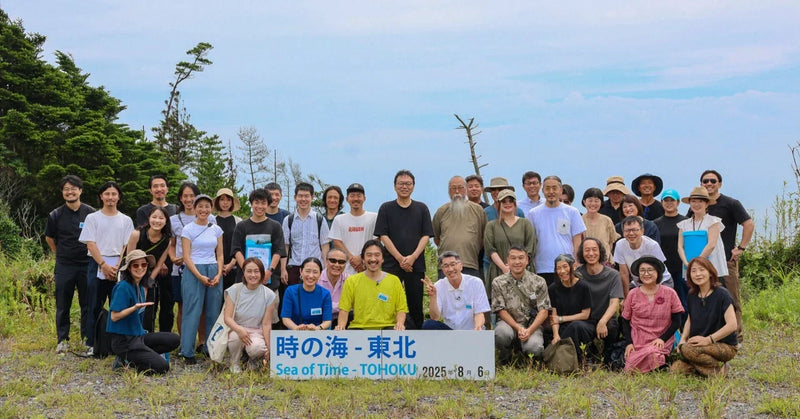
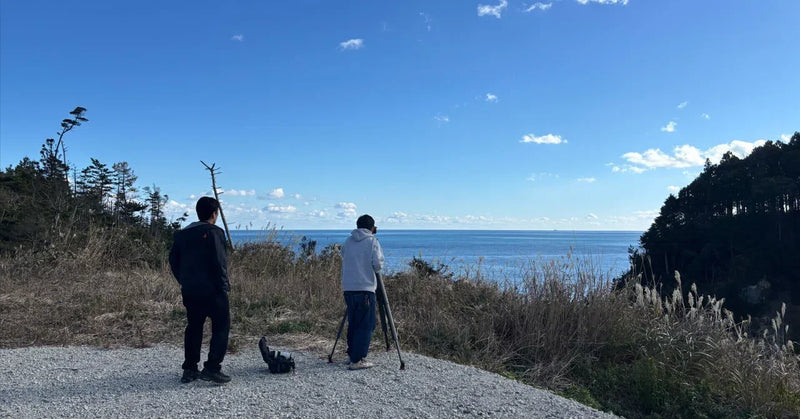
The "Sea of Time - Tohoku" project is based on the concepts of "it changes continuously," "it connects with everything," and "it lasts forever." This project is being created by Tatsuo Miyajima, a contemporary artist known for his works using digital counters, with the people living in Tohoku and those who care about Tohoku, with the desire to console the victims of the Great East Japan Earthquake and pass on the memory of the disaster.
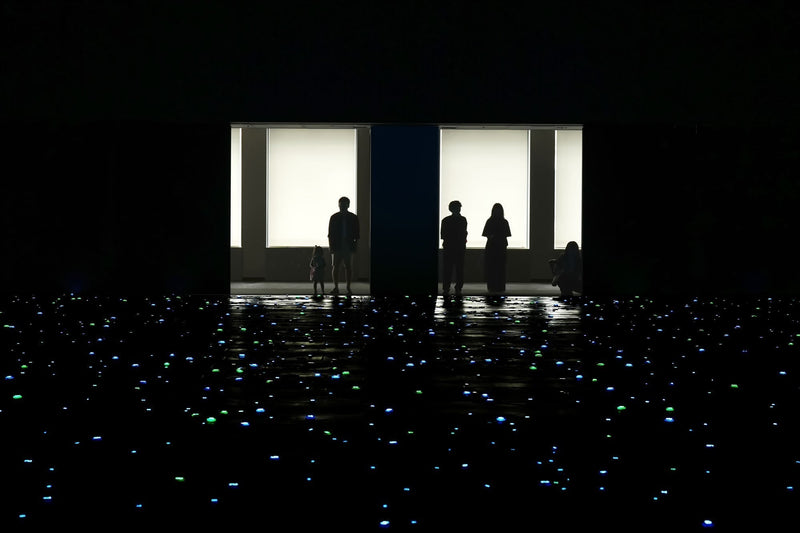
The artwork, which is envisioned to have 3,000 LED gadgets counting "1 to 9" or "9 to 1" installed in a huge pool, involves 3,000 people. Each participant can set the counting speed of their LED number to their desired time. Workshops are being held throughout Tohoku, with the goal of completing the artwork in 2027.
Last year, on March 11, 2021, the 10th anniversary of the disaster during the COVID-19 pandemic, the first online workshop was held. Furthermore, from October to December, new initiatives were challenged, such as holding online workshops with sign language interpretation, and currently, the number of participants has reached 1,254 (as of December 11, 2021).
This article reports on the online workshops held from October to December last year, from the perspective of Tae Yoshihara ("Sea of Time - Tohoku" Project Director), who planned and designed the workshops and served as moderator on the day.
Online Workshop | What is Time Setting?
In the fall of 2021, a total of four online workshops were held on October 24, November 27, November 28, and December 11.
As the start time arrived, participants' faces began to fill the Zoom screen, responding to Tatsuo Miyajima's call of "Good evening~!"
The online workshop began with Miyajima explaining the background of the "Sea of Time - Tohoku" project, the workshops held in various locations in Tohoku so far, and about time setting.
※For details on the project's background, please refer to: "Vowing for the Future from Here and Now. Reflecting on Those Times and People with Those Who Care About Tohoku | Interview with Contemporary Artist Tatsuo Miyajima on the 'Sea of Time - Tohoku' Project."
 Miyajima explains his past activities, interspersing photos and videos
Next, **Miyajima takes ample time to engage in one-on-one conversations with each participant. This conversation time is what is most valued in the "Sea of Time - Tohoku" project.**
During the conversations, Miyajima asked participants the following questions:
- Where were you on March 11, 10 years ago? What did you feel at that time?
- What was your reason for wanting to participate in the "Sea of Time - Tohoku" project workshop?
- How many seconds will you set for your time setting? Why did you decide on that number of seconds?
**Time setting involves asking each participant to set the counting speed of the LED gadget used in the "Sea of Time - Tohoku" artwork to their desired number of seconds (from 0.2 to 120 seconds), and then listening to what they felt when they chose that number and what their thoughts are about this project.** Some participants have already decided on their number of seconds, while others think about it as they participate in the workshop. When someone is struggling, "Hmm... what should I do?" Miyajima encourages them by saying:
"I think it should be a number you won't forget. A number that holds your feelings. For example, your birthday or the birthday of someone important to you, or a number that is important to you, like a lucky number, would be very good."
In this way, the LED gadgets, each filled with the participants' thoughts, become part of the artwork.
 Time setting can still be participated in via the "Sea of Time - Tohoku" website.
Each Person's 3.11 | Sharing Experiences, Receiving Thoughts
Listening to the experiences of the Great East Japan Earthquake and understanding what led to their chosen time setting, the online workshop became a time for everyone, not just Miyajima, to attentively receive each person's thoughts. Here, we present some of the dialogues, including shared experiences and the thoughts behind their time settings.
 The time setting process, conversing with each participant.
— An Encounter with Miyajima's Work as a Catalyst —
Miyajima: Where were you on March 11, 10 years ago, and what do you remember?
K-san: I was in third grade when the earthquake hit. I remember watching the news and it felt unreal, like watching a sci-fi movie. So, it was more like, "What?!" a kind of shock, I guess.
Miyajima: What prompted you to participate in this workshop?
K-san: **Actually, I saw Miyajima-san's work for the first time at the 'STARS Exhibition' at the Mori Art Museum. I was deeply moved by it. It had a huge, sacred atmosphere, and I watched it for two or three hours straight.** There, I learned about this opportunity to participate in this project, and that's what made me want to join.
Miyajima: Thank you. So, K-san, how many seconds will you set for your time?
K-san: 2.7 seconds, please. The reason is that if you divide 24 hours in a day by the numbers 1 to 9 that count, it's approximately 2.7 seconds. So, I'll go with this number.
— Thoughts for Fukushima —
M-san: My father is from Aizu, Fukushima Prefecture. My mother is French, and at the time, she apparently received an instruction from the French embassy to leave Japan immediately because the nuclear power plant was dangerous. I was in junior high school at the time of the earthquake, and I didn't know anything about it. Suddenly, my parents told me we were moving from Tokyo to Kyoto.
Miyajima: At that time, it was later revealed that the American embassy had also issued an evacuation order to Americans in Japan, wasn't it?
M-san: That's right. Because of that experience, my image of the Great East Japan Earthquake is very strongly associated with the nuclear power plant. A few years ago, when I went to my family home in France, I was shocked and had very mixed feelings when I heard from my French relatives that Fukushima was still contaminated and they didn't want to go there.
**For me, Fukushima is a place where I have very fond summer and winter memories. It has beautiful scenery not found in cities, and the food is incredibly delicious. So, after the disaster, I have mixed feelings about the image of FUKUSHIMA being left behind by the nuclear power plant.**
Miyajima: So, the image of Fukushima, a place important to you, was damaged, and you had such mixed feelings, didn't you?
M-san: That's right. One of the reasons I participated in this workshop was that **even though I wasn't in Fukushima at the time and wasn't directly affected, I hoped that by participating in this project as an outsider, I could continue to harbor feelings for Fukushima as an individual and with my own emotions.**
Miyajima: That's very important, isn't it? When I meet people from Tohoku, they always tell me how encouraging it is for the victims there to know that people who weren't directly affected at the time, who went to volunteer, and who continue to care about Tohoku even after so much time has passed. So, I think your feelings, M-san, are wonderful. So, what about your time setting in seconds?
M-san: Please set it to 2.2 seconds. This might sound a bit negative, but I once heard that people die in about 20 seconds when exposed to very strong radiation from an atomic bomb. Since 20 divided by 9 is 2.22222..., I chose this number.
Miyajima: I see. By making it a negative and frightening number, it creates a powerful impact, and I think it's good that it expresses your feelings, M-san, a sense of anger, perhaps.
— The Landscape Two Years After the Earthquake, with Prayers for the Deceased —
N-san: On March 11, ten years ago, I didn't experience direct damage because I lived in Chiba Prefecture. Currently, I am a Buddhist priest. At the time of the earthquake, Buddhist priests gathered and discussed what we could do, but local priests told us not to go yet, saying it would only cause trouble. Two years later, I was finally able to go to the affected area. I walked through the streets chanting sutras and held a memorial service on the coast. Two years later, the remnants of the tsunami were still vividly present in the town.
**Sometimes, by forgetting painful events, people can alleviate their suffering. I think that's important. But on the other hand, I also believe it's crucial to pass on experiences and lessons. That's why I agreed with the concept of this project and Miyajima-san's artwork and participated.**
Miyajima: That's right. Just as one forgets the heat once it's past the throat, people generally forget. I myself hope that through my artwork, I can provide an opportunity to reflect on such experiences. So, N-san, what will be your time setting in seconds?
N-san: I think I'll go with 13 seconds.
Miyajima: Is that number meaningful to you, N-san?
N-san: As a Buddhist priest, 13 is a very profound number for me. Also, I want to include my prayers for the repose of souls in this number.
 On January 27 and 28, the first workshops with sign language interpretation were held.
— Becoming a Part of Someone Else's Precious Work —
T-san: Ten years ago, in March, I was working as a director for an information program at a TV station in Tokyo. When the earthquake hit, I was in the TV station considering the next取材. Actually, TV stations have well-developed systems, and there's a system that can detect the epicenter before the shaking even begins. So, I saw an indication that an earthquake with its epicenter in this area of Tohoku was about to strike a few seconds before I felt the shaking, and then I felt the strong shaking in Tokyo. I remember thinking, "Even though the epicenter isn't in Kanto, if the shaking is this strong, Tohoku must be in a terrible state." After that, I spent about two weeks, until the end of March, covering various parts of Tohoku.
Miyajima: I see. That must have been an incredible experience. Back then, the Tohoku Expressway was full of holes and impassable, there were traffic jams everywhere, and gasoline ran out. It was a tough time, wasn't it?
T-san: It was tough. Even though the expressway was closed, our reporting team was actually able to drive on the closed expressway on March 12th and 13th. At that time, there were many people walking on the expressway. Many people were walking to search for their family members whom they had lost contact with. I still remember that sight.
Miyajima: T-san, what motivated you to participate in this project?
T-san: I love Miyajima-san's work, especially the pieces housed at the Museum of Contemporary Art Tokyo. Whenever something happens, I go to see those works, sit on a bench, and contemplate while looking at them, so I feel like they've walked through life with me. Also, I'm participating in this project as a "support artist."
Miyajima: Thank you. The "Sea of Time - Tohoku" project is seeking both participants (collaboration artists) and financial support (donations) to realize the project, and we position those who provide financial support as "support artists." You participated in that, didn't you?
T-san: I'm really happy to be involved as part of the artwork. And what's more, it will continue to exist as an artwork. In that case, just as I pondered various things while gazing at Miyajima-san's work, it might one day become such an artwork for someone else. I participated with that hope.
For the time setting, I'd like 3 seconds, please. It also has the meaning of March, and I want to move and be involved more and more rapidly from now on, so I want to choose this time where the count changes quickly.
— A Happy Family Number —
O-san: When the earthquake struck, I was an elementary school student and experienced the earthquake in my classroom. I lived in Urayasu City, Chiba Prefecture, and it was the biggest earthquake I had ever experienced. It was shaking so much that I wondered why.
Miyajima: Weren't you allowed to leave school? Did you have to wait at school until your guardians came to pick you up?
O-san: That's right. We waited on the playground. I remember talking with my friends, saying things like, "If we were in an airplane flying overhead, it wouldn't have shaken."
Miyajima: What motivated you to participate this time?
O-san: Someone recommended it to me, saying it would be fun to participate. I've been thinking a lot since the workshop started.
Miyajima: I see. So you participated after someone told you about it. The LED gadget with the number you chose, O-san, will also become part of the artwork, so I would be very happy if this workshop and artwork provide you with an opportunity to think. And I hope it will be an opportunity for you to reflect on Tohoku again. So, what about your time setting, O-san?
O-san: **Please set it to 10.2 seconds.**
Miyajima: Is there a reason for this number?
O-san: My parents' wedding anniversary is October 20th, and **it's a number that represents our family's closeness, so I chose that number. I thought it might bring a little peace.**
Miyajima: That's wonderful! It's truly a blessing to have such a happy number dedicated to the "Sea of Time - Tohoku" project.
There are people in Tohoku who suffered from the disaster who lost their partners, or their beloved children, and some fathers are still diving into the sea searching for their daughters. So, in that sense, I hope that by dedicating a happy and hopeful number, the wish and thought that no terrible disaster will come in the future will be conveyed.

— Each Spouse's Thoughts —
S-san: I'm from Aomori, but I was in Sendai at the time of the earthquake.
Miyajima: In Sendai? Oh, that must have been terrible.
S-san: When it shook, I was at work, and it was a building that had always been said to be sturdy, so I wasn't too worried. But that kind of earthquake was truly astonishing.
Miyajima: Was your home okay?
S-san: Our house was quite far from the sea, so there was no tsunami damage. But many roof tiles fell off. It was difficult enough to require re-renovation, but the house wasn't uninhabitable.
Miyajima: Even in Sendai, it must have been really hard then, without food and everything. And life after that too.
S-san: I was a company man, going to work every day and staying overnight, you know. My wife worked really hard. She's right next to me now. She went to the water station every day and waited in line for half a day, but the water ran out a few people before her, and she came back empty-handed.
Miyajima: I see. Even for those living in Sendai city, you must have experienced such hardships. What was your motivation for participating in this workshop this time?
S-san: **Originally, I love art. I think everyone who works for a company has tough times, and when I was young, art healed me during those times.** I was also familiar with Miyajima-san's work, having seen it in Naoshima, but when I heard about this workshop, I immediately wanted to participate and signed up.
Miyajima: Thank you. I can hear your wife M-san's voice, so would you like to participate? Even just your voice is fine. So, first, what will be your time setting, S-san?
S-san: **At the time of the earthquake, I was 57 years old. So, I'd like to set it to 57 seconds. I want to include the feeling of never forgetting that day.**
Miyajima: Thank you. So, what about your wife, M-san?
M-san: Thank you. Please set it to 3 seconds, my favorite number.
Miyajima: Understood. M-san, you also had a tough time, didn't you?
M-san: That's right. But my husband's company also had a tough time, didn't it? He was in telecommunications, so all the infrastructure was completely out.
Miyajima: That's right. Your husband fulfilled his mission, and you, as his wife, supported and protected him, didn't you?
 Some participants were parents and children.
— Reflecting on 10-Year-Old Memories with Family —
Participating as a family: mother (K-san), eldest son (H-san), second son (A-san)
Miyajima: Where were you all on March 11, 10 years ago?
A-san: I wasn't born yet!
Miyajima: Oh, that's right! You weren't born yet.
K-san: I was at work. The moment it shook, I instinctively hid under my desk. And the first thing I thought of was my children. I lived in Arakawa Ward, and my eldest son, who was two years old at the time, was in a nursery school in a densely packed wooden area, so I thought, "This is bad..." That was the first thing that crossed my mind. I left my company in Ryogoku and went outside, the ground was cracked and it was chaotic, and I walked through it to the nursery school.
Miyajima: It must have taken a long time to get to the nursery school, didn't it?
K-san: I was allowed to leave work at 4 PM and arrived at the nursery school at 7:30 PM. On the way, in areas with many old buildings, the exterior walls of buildings fell off during strong shaking. I walked home through all that, and when I finally arrived at the nursery school and saw my child's face, I felt a great sense of relief. That's my memory from 10 years ago.
Miyajima: H-san, do you remember anything from that time?
H-san: All I remember is that there was a sudden strong tremor, and then the teacher told us to quickly hide under our desks, and I hurried under the desk. And also, that it was a tremendous shock.
S-san: Over 10 years, I've learned so much I didn't know. Including the nuclear power plant issue, I knew absolutely nothing until I was over 30. I felt very ashamed of that, and from a desire to absolutely never forget Tohoku, I participated this time.
Miyajima: Thank you. I truly believe that the people of Tohoku would be very happy if you poured your thoughts into this. When I visited Tohoku several times, the people of Tohoku welcomed me so warmly. On the contrary, I often felt encouraged by them.
They all uniformly say, "Please don't forget Tohoku." So, I think your desire not to forget, S-san, is very encouraging to the people of Tohoku. H-san, do you have any thoughts about participating?
H-san: **At the time of the earthquake, I was little, and I don't think Tokyo suffered major direct damage. So, precisely because of that, I wondered if it was okay to remain ignorant of the experiences of the people in Tohoku? Was it okay to remain indifferent? That was one thought I had.** It's difficult, but I thought there must be something I could do, so I decided to participate in this workshop.
Miyajima: That's amazing. H-san, how old are you now?
H-san: I'm 14 now.
Miyajima: Wow! That's amazing for a 14-year-old. So, H-san, what will be your time setting?
H-san: I'll choose 3 seconds. It's my favorite number, and 3 has the image of a triangle. It's a stable and very strong shape, so I think 3 is a special number.
Miyajima: That's good. How about you, A-san?
A-san: 16 seconds, please. It's my birthday date.
Miyajima: A birthday, that's nice. Now, K-san, you were quite troubled, how about you?
K-san: Hmm, I thought about it, but I'll go with 0.3 seconds! I want to remember March, when the earthquake happened.

— Wanting to Honestly Know the Experience and Feelings of 3.11 —
Y-san: My motivation for participating was, first, that sign language interpretation was provided, and **I invited a friend to this workshop. I had a desire to hear about their 3.11 experiences and feelings at the time, and I also wanted to learn about the experiences of other participants.**
Speaking from my own experience, I wasn't greatly affected by the earthquake myself, so I had forgotten about it. However, I thought it was important to learn and recall those feelings by listening to other people's stories about the earthquake, so I participated.
Miyajima: I'm truly delighted that you participated with such pure feelings. As I mentioned earlier, I believe that imagining the feelings of the people of Tohoku is what truly uplifts them.
Y-san: I see. So, not forgetting is important, isn't it?
Miyajima: That's right. The "Sea of Time - Tohoku" project is also about not forgetting, and doing it through art.
Art is something that really trains your imagination. The ultimate imagination is the ability to feel someone else's pain, the pain of others, as if it were your own. So, when you, Y-san, truly want to know what the people of Tohoku felt, and what other people felt, that is expanding your imagination more and more, isn't it?
So, Y-san, how many seconds will you set for your time?
Y-san: I'll set it to 19 seconds. My attendance number in elementary school was 19, and it's also my lucky number.
— Wishing to Preserve the Fleeting Existence of Family —
K-san: Ten years ago, on March 11, I was in 4th grade and spending my spring break at my parents' home in Hiroshima Prefecture. I remember eating homemade pizza while watching TV there. I was watching international news at home when an earthquake report from Japan came in as breaking news. I immediately switched to a Japanese TV program and saw footage of the tsunami.
Miyajima: I see. So you learned about the earthquake from TV news footage. Was it shocking, after all?
K-san: No, actually, **the truth is that for me, as a 4th grader, Tohoku felt too far away to be real.** After that, I read about the Great East Japan Earthquake in children's newspapers and other publications, including that the tsunami reached the height of a 13-story building. I looked up at my own apartment building and was shocked, thinking that the tsunami had reached that high, but it still felt somewhat unreal. That was partly because I was an elementary school student, and also because Hiroshima Prefecture, where I lived, was a place where tsunamis and earthquakes rarely occurred.
Miyajima: Because it's the Seto Inland Sea, with its calm expanse of ocean. So, K-san, what made you want to get involved with the "Sea of Time - Tohoku" project?
K-san: **To my embarrassment, I actually didn't know about this project. But my friend Y-san, who was just talking, invited me to join.** I thought it was wonderful that they were addressing the experience of the Great East Japan Earthquake through art, and that it would be installed in a place where you can see the Tohoku sea. **Participating this time, I realized that on that same day 10 years ago, many people had many different experiences in many different places, and I feel it was a very good experience.**
Miyajima: Thank you.
Regarding the sea, you know. When I interviewed people I met in Tohoku, not a single person spoke ill of the sea. That was very mysterious to me. Everyone living on the Tohoku coast has walked with the sea through both joy and sorrow. So, I believe the people of Tohoku have deep and strong feelings towards the sea.
This project is moving forward with various people, like you, K-san, who have different perspectives, who are interested and participate in this way, and who bring together various thoughts. So, I am very happy that you participated. So, K-san, what will be your time setting in seconds?
K-san: **82.6 seconds, please.**
Miyajima: Oh, that's a rather complex number. What does it mean?
K-san: I was preparing to study abroad, and I had the opportunity to look at my family register recently, and the date of my birth registration was August 26th.
Miyajima: Family register! I see.
K-san: I felt that this was the day, in this place, that my family came into being. **This year, I started living alone, and it made me realize again how important my family is. So, I thought about what kind of light I wanted to keep lit forever, and I decided that I wanted to keep my family shining, so I chose this number.**
Miyajima: That's a heartwarming story. I truly appreciate you dedicating such warm thoughts and light to Tohoku through the "Sea of Time - Tohoku" project. When the artwork is complete, please come and see the "Light of Family" with your family.

 Time settings were made while sharing various thoughts.
The "Sea of Time - Tohoku" Image and Sign Language Expression
This time, sign language interpretation was provided for the first time at the online workshops on November 27th and 28th. This was to allow people from diverse backgrounds to share their memories and experiences of the disaster, and the thoughts they had held, through the "Sea of Time - Tohoku" project, and to reflect on their future while looking back at loved ones and the events of that day. We wanted to make this project more broadly accessible as a place to foster such opportunities. This was undertaken as a step towards updating the project's accessibility.
**During the preparation, the sign language interpretation team asked, "What kind of image does 'Sea of Time' in 'Sea of Time - Tohoku' convey?"** If expressed literally, it would be a gesture for "time" (pointing to a wrist-watch) + "sea" (clenching the left hand into a fist like a rock, and using the palm of the right hand like a wave hitting the rocky shore). However, the sign language interpretation team questioned if this felt quite right.
**In response, Miyajima explained that the "time" in "Sea of Time - Tohoku" represents "an image of the timeline connecting from past to present to future."**
Then, the sign language interpretation team proposed an expression: "history" (rotating both thumbs and pinkies as if stirring) + "to pass" (tracing the left arm towards the left wrist with four fingers of the right hand) + the sign language expression for "sea."
 **"Sea of Time" is an image of "the sea where time passes,"** which led to this sign language expression.
"Wow! This is truly an expression. Sign language visualizes images, doesn't it?" Miyajima exclaimed, deeply moved.
Indeed, sign language can convey images visually, like a video. This incident made us realize that once again, and a unique sign language expression for this project was born.
You are also an artist.
In 2022, we will mark 11 years since the Great East Japan Earthquake. This year, we plan to challenge new initiatives and open new avenues for participation in the "Sea of Time - Tohoku" project. Information on workshops and other events will be announced on the website's news page as they become available.
Additionally, you can continue to participate in time settings via the website, so please access it if you are interested.
Furthermore, future project developments and progress reports will be released on Note as needed. Please look forward to our future activities!
Event Outline
"Sea of Time - Tohoku" Project Online Workshop ~ A Moment to Ponder Loved Ones ~
Dates:
October 24, 2021 (Sun) 19:30-21:00
November 27, 2021 (Sat) 19:30-21:00 *With sign language interpretation
November 28, 2021 (Sun) 19:30-21:00 *With sign language interpretation
December 10, 2021 (Sat) 19:30-21:00
*Sign Language Interpretation Coordinator: Natsumi Wada (Interpreter)
Sign Language Interpreter: Tomomi Komatsu
Sign Language Interpreter: Yuko Setoguchi